For the last five years we found our own marketing advantage with clients.
Our entire approach was built around establishing a buyer narrative. Instead of mapping the demand gen motion to pains that map to a product, we’d map a shift happening in the buyer’s world that created life-or-death stakes.
Then we’d leverage paid media, content and distribution around that narrative, and for years that was enough to drive serious momentum and help clients hit targets for quarters on end.
It was literally the advantage the marketing motion needed to hit targets.
Now this alone isn’t even enough.
The motion used to be the move
At one point the demand gen motion itself was the winning move. You’d dial in your messaging and positioning and then you’d go to market.
You could crush paid media and then layer on. Layer on content marketing and SEO. Layer on events and webinars. Each new channel and tactic made the whole thing stronger and lifted your KPIs and pipeline.
Now every one of these is the cost of entry.
Everyone in your category is running them. Every channel and nearly every tactic is oversaturated. There is still plenty of upside in executing them well, but it is incredibly hard to create a real advantage simply by chaining more channels and tactics together.
Joergen and I spent a whole episode on this, on why the motion isn’t momentum anymore.
What a winning move is actually made of
When I look at the winning moves we’re trying to build right now, I keep coming back to three places:
The first is an offer that gives you a massive advantage in acquisition costs and can’t be replicated without real investment from a competitor.
The second is an ownable buyer narrative that would require your competitors to actually shift their business strategy if they wanted to tell the same story. That’s the bar for narrative work now.
And the third is distribution that’s genuinely defensible, not “we’re going to run paid ads” or “we have a newsletter,” but some mechanism that gives you reach or access your competitors can’t recreate by opening the same ad platform or buying the same list.
The bar for all three is basically the same. If a competitor wants to copy it, it should require considerable investment or a meaningful shift in how they operate. Ideally both are painful.
A winning move is often made up of all three of these working together.
The offer is where this gets real
This is the part I think we need to completely rethink.
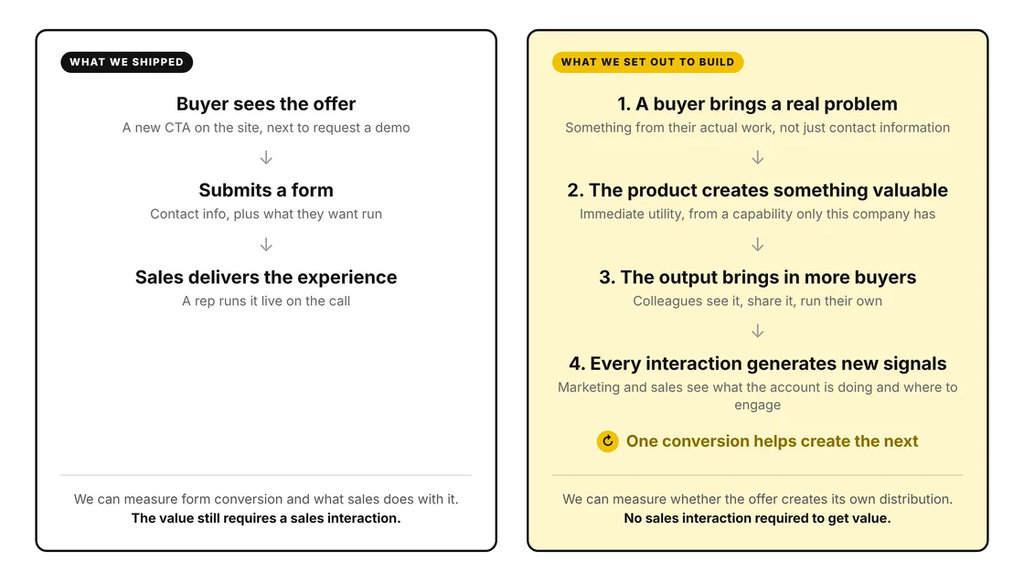
When I start talking with marketing teams about offers, the conversation almost immediately goes to the same places. An assessment. An ROI calculator. A white paper, or some other thing whose actual offer is still basically talk to sales or get into our database so we can pitch you and email you.
That’s not what I’m talking about.
If the offer is going to create an actual advantage and be part of your winning move, the bar has to be much higher. It needs to give the buyer real value before they ever talk to sales, and ideally it gives them a reason to come back again. It should use something your company actually has that other companies don’t, whether that’s your product, your data, your expertise, your network or some combination of those things.
And building something at that level starts to look a lot less like campaign planning and a lot more like product development.
Which brings me to one of the best marketing leaders I know.
The outlier
She told me recently that she feels like the outlier in almost every CMO conversation she’s in.
The thing is, she built one of the clearest examples I’ve seen of what I’m talking about.
Her company built an offer around data only they have. Buyers can use it without talking to sales. Her SDRs use it to convert meetings. In the same conversation she said, honest to God, where would we be without this tool?
Then she told me what it actually took.
I pushed her into it, and eventually it became a huge part of her job. For about nine months she was basically the product manager for it. She fought internally to get it greenlit, outsourced the build and put nearly $200k of marketing budget behind it.
Her words: I don’t regret it. It’s the best thing I ever did.
That’s the part I keep thinking about because when you tell a marketing leader they need a winning move, their brain naturally goes to marketing.
What’s the campaign? What’s the channel? What’s the play? What’s the creative?
This didn’t look like that.
This looked like a CMO spending nine months helping build a product just for marketing.
And everything she built is incredibly specific to her company. That’s part of why she feels like the outlier. It doesn’t compress neatly into a framework she can explain on a podcast that another CMO can take back to the office and copy on Monday.
Going into 2027 we’re putting more investment into that same offer, we’re building defensible distribution into the offer itself, and we’re reinventing the narrative around where the market is going.
All three.
I’d hate to be competing against her going into 2027.
Why this rarely gets the investment
This is what it actually takes to build a winning move. Not a campaign that works for a quarter, but something you build, treat like a product and keep investing in until your marketing itself starts creating an advantage.
Pulling all of that off can easily become a six-to-twelve-month journey, and the reason almost nobody does it isn’t that marketing teams are incapable of coming up with good ideas. It’s the doing.
They hear the idea and say, that’s a great idea, but we don’t have time for that right now. It often feels more like a distraction from the current targets. And after every quarter there is always another quarter.
I’ve been asking the same question back for years. What are you going to do in six months?
She’s one of the few marketing leaders who actually answered it.
The motion still matters, and we still need to execute the hell out of it. We just can’t keep expecting the motion itself to create an advantage that no longer.