
Episode 1 of Winning Moves is live. You can check it out here.
That was filmed about ten weeks ago, and I’m a lot further into this than what you’ll see in it.
Since then I’ve walked several of our customers through what their winning move actually is, and I want to give you the real version of what happens when you try to build one inside a demand gen motion that gets measured every single week.
Real offer work is freaking hard
One of the teams we’re working with has the pieces of a real offer sitting right there. Sales is already using a version of it on nearly every call, so we know it works and we know buyers get real value out of it the second they see it.
Here’s what I want to build with it.
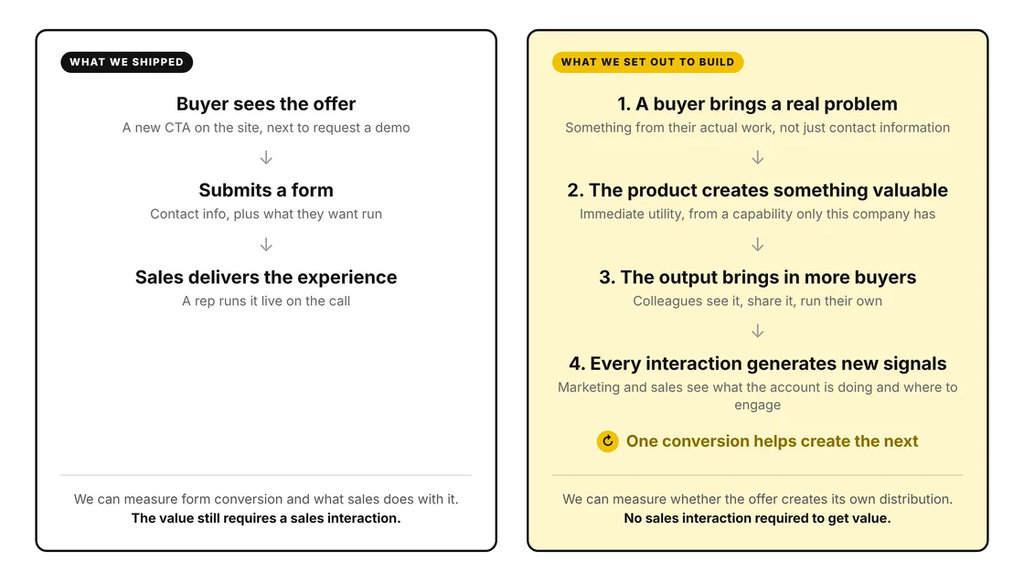
A buyer brings something real from their actual work, not their contact info. The product turns it into something useful in seconds, using a capability only this company has. What comes back is the kind of thing you’d send to a colleague, so other people on the buying team end up in the experience without us paying to get them there. And every time someone uses it, we get a signal on what that account is doing and where to engage.
So instead of paying for every single conversion, one conversion helps create the next. That’s the advantage. Nobody else in their category has anything like this.
In the first issue I said building an offer at this level looks a lot less like campaign planning and a lot more like product development. I meant it. This is a product.
Ten weeks in, here’s where it stands.
I settled for a form
The real build was two to three months of dev work, and we had results to keep moving in the meantime, right? So we shipped the version we could ship. A buyer submits what they’ve got, a rep runs it live on the call. At least it’s different than request a demo.
That was ten weeks ago. We’re still at a form, and there’s been no progress on the thing that actually needs to happen.
The build we didn’t start would be done by now.
Ten weeks later
The form keeps the one thing we could already measure, which is whether a buyer will ask sales for something. It removes everything that was supposed to be the advantage. No instant value, nothing to send to a colleague, no signal past the form fill.
It’s not a smaller version of what we want to build, it’s a different demand gen system. You can test interest in an offer with a form. You cannot test whether an offer creates its own distribution, because the form is the thing standing in the way of that.
And that’s the part that actually went sideways. The form was supposed to be a first step. Instead its numbers quietly became the thing that decides whether it gets the resources and investment.
So the thing I settled for is now the thing being judged, and it was never built to prove the bet.
Why it goes this way, every time
Results are tight, the numbers aren’t where they expected. Everybody opens the dashboard, and there is always something to pull. Ads, landing pages, AI search dipped, paid is down in Salesforce.
You spend the week on it, it recovers a little, and then something else slips.
This is the sh!t I’m fighting nearly every day.
A client of mine gave me the best name for this work I’ve heard. Incremental micro wins. They’re the right things to do, you just never really see them in the end numbers.
And once a team lives there long enough, every new idea gets pulled into the same place.
I walked a different executive team through how we’re going to win in 2027. A real plan, nothing like it in their category. The first comment out of the room was “I don’t want us to get distracted from what’s working.”
Every marketing team is running two modes at once, optimizing what you have and building what you don’t, and neither one ever turns off. The whole question is which one has the throttle.
Right now, for almost every team I talk to, it’s pinned on optimization, and a move that needs quarters is trying to run on whatever’s left over at the end of the week.
Where a winning move actually lives
Here’s what nobody wants to hear.
The small version can’t prove it for you. And the data isn’t going to show up in time to make the decision for you.
In the first issue I said you’ll never have enough data to optimize your way to your targets. This is the other side of that. You won’t have enough to prove the move either. At some point you build it because you know your market, your buyers, and your product well enough to know.
I’ve been doing this long enough to know that testing and optimizing isn’t going to get you where you need to be. And deep down, you’ve always known that too.
So here’s the question I’d take into your next planning meeting. Are we measuring the move, or are we measuring the thing we built to get moving?
Ten weeks in, we haven’t started the real build. The question for us is whether we push it to what it needs to be before next year’s targets show up and pull everyone back to optimization.
I don’t know the answer yet.

